GEO vs SEO: How to Get Your Business Recommended by ChatGPT in 2026
Search is evolving beyond Google. Learn the 6-step GEO framework to optimize your content for ChatGPT, Perplexity, and other AI platforms that are redefining how customers discover businesses.
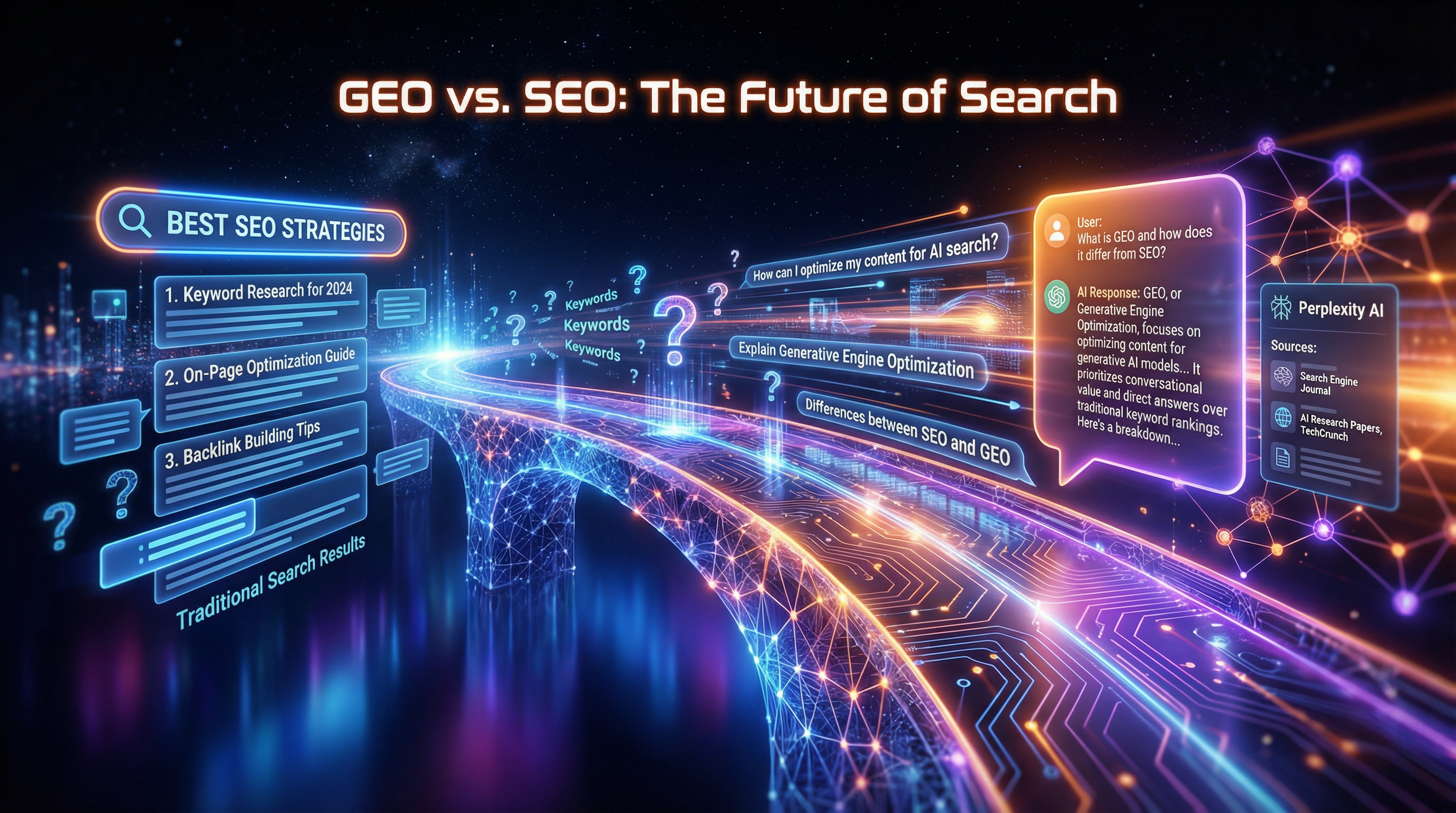
GEO vs SEO: How to Get Your Business Recommended by ChatGPT in 2026
Meta Description: Traditional SEO is no longer enough. Learn GEO (Generative Engine Optimization) strategies to get your business recommended by ChatGPT, Perplexity, and AI search tools in 2026.
---
A fundamental shift is reshaping how customers discover businesses in 2026. When potential clients need a service, they're no longer typing keywords into Google—they're asking ChatGPT, Perplexity, and other AI platforms for recommendations. This behavioral change has created a new competitive battleground: visibility in AI-generated responses.
The challenge is stark. Traditional SEO strategies that dominated for two decades are suddenly insufficient. Ranking on page one of Google matters less when your target audience never opens a browser. The question keeping marketing leaders awake isn't "How do we rank for our keywords?" but rather "How do we get recommended when someone asks AI for help?"
This is the domain of Generative Engine Optimization (GEO)—a discipline so new that, as one practitioner noted, "no one has cracked the code"[1]. Yet the early movers who figure it out will capture disproportionate advantage, dramatically increasing their chances of being included in the AI-powered recommendations that are replacing traditional search results.
The Death of Keyword-Based Thinking
Traditional SEO operated on a simple premise: identify the keywords your customers search for, optimize your content around those terms, and climb the rankings. This model worked because search behavior was predictable. People typed three-word phrases into search boxes. "Digital marketing agency Hong Kong." "Growth marketing consultant Beijing." "SEO services China."
AI search has demolished this paradigm. When someone opens ChatGPT, they don't type keywords—they ask questions in natural, conversational language[1]. "I'm launching a SaaS product in Hong Kong and need help with growth strategy. Which consultancies should I consider?" or "What are the best agencies for data-driven marketing in the Greater Bay Area that understand both Chinese and Western platforms?"
The difference isn't merely stylistic. Keyword-based queries assume the searcher knows what they're looking for and how to describe it. Conversational AI queries reveal uncertainty, context, and nuance. They include details about budget constraints, previous experiences, specific challenges, and decision-making criteria. The odds that your target customer will use the exact three-word phrase you optimized for approaches zero[1].
This shift forces a fundamental reconceptualization of optimization strategy. GEO isn't about ranking for keywords—it's about being cited as a relevant answer to the infinite variations of questions your ideal customers might ask AI platforms.
Understanding How ChatGPT Pulls Information
To optimize for AI recommendations, you must first understand the mechanism. When ChatGPT responds to a query about businesses or services, it draws from several sources: websites it has crawled and indexed, details it highlights from those sites, and patterns it has learned about which companies are frequently mentioned in authoritative contexts[1].
This creates three optimization vectors. First, your website must be structured in ways that AI can easily parse and understand. Second, the content must clearly articulate not just what you do, but who you serve, what problems you solve, and what makes you distinctive. Third, you need to appear in contexts where AI platforms learn to associate your brand with specific needs and solutions.
The challenge is that AI platforms don't publish ranking algorithms or optimization guidelines. There's no equivalent to Google's Search Console showing you which "queries" triggered recommendations. The optimization process requires hypothesis-driven experimentation, careful tracking of when and how your business appears in AI responses, and continuous refinement based on patterns you observe.
The Six-Step GEO Framework
Drawing from early practitioners who have begun systematically testing GEO strategies, a six-step framework is emerging as the foundation for AI visibility[1].
Step 1: Find Your Key Queries
This doesn't work like traditional keyword research. You're not identifying search terms—you're mapping the different ways people might ask AI about the problems you solve. Start by considering your buyer personas. What challenges keep them awake at night? What questions would they ask a trusted advisor? How might they describe their situation to an AI assistant?
For a growth marketing consultancy, relevant queries might include: "How do I scale customer acquisition in Hong Kong without burning through my budget?" or "What's the difference between growth marketing and traditional digital marketing for B2B SaaS?" or "I need help choosing between hiring an in-house growth team versus working with a consultancy—what should I consider?"
The goal is to build a comprehensive bucket of different ways people may look for what you offer, understanding that you're not trying to rank for these phrases—you're trying to ensure AI platforms recognize your business as a relevant answer when these topics arise[1].
Step 2: Audit Your Current AI Visibility
Before optimizing, establish a baseline. Systematically test how AI platforms currently respond to your key queries. Open ChatGPT, Perplexity, Google's AI Overviews, and other relevant platforms. Ask your target questions. Document whether your business appears, how it's described, what competitors are mentioned, and what sources the AI cites.
This audit reveals gaps and opportunities. You might discover that AI platforms mention your competitors but not you. Or that when you are mentioned, the description focuses on services you've deprioritized. Or that the AI cites outdated information because your website hasn't been updated to reflect your current positioning.
Step 3: Optimize Your Digital Footprint for AI Parsing
AI platforms need clear, structured information to understand and recommend your business. This means rethinking how you present information on your website and other digital properties.
Create dedicated pages that explicitly answer the questions your ideal customers ask. If prospects frequently wonder about the difference between your approach and traditional agencies, write a page that directly addresses that question. If they're uncertain whether they need a consultant or an in-house team, create content that helps them think through that decision.
Use clear, semantic HTML structure. AI platforms parse headings, lists, and structured data more effectively than walls of text. Break complex information into scannable sections with descriptive subheadings. Use schema markup to explicitly label key information like services offered, industries served, and geographic focus.
Ensure your "About" page clearly articulates not just company history, but your specific expertise, approach, and the types of clients you serve best. AI platforms frequently pull from About pages when determining whether a business is relevant to a query.
Step 4: Build Authority Through Strategic Content
AI platforms learn which businesses to recommend partly by observing where they're cited and discussed. This makes content marketing and thought leadership more valuable than ever—not for direct traffic, but for training AI models to associate your brand with specific expertise.
Publish in-depth articles that demonstrate genuine expertise on topics your ideal customers care about. These shouldn't be keyword-stuffed SEO content—they should be substantive pieces that other sites want to link to and reference. When authoritative sources cite your content, AI platforms learn to view your business as a credible source on those topics.
Participate in industry publications, podcasts, and conferences. Each mention in a reputable context reinforces to AI platforms that your business is relevant and authoritative. The goal is to create a web of citations and references that make it obvious to AI systems that when someone asks about your domain, your business should be part of the answer.
Step 5: Leverage Structured Data and Schema Markup
While AI platforms don't publish explicit guidelines, evidence suggests they prioritize content with clear structured data. Implement schema markup that explicitly labels your business type, services, location, and expertise areas.
Create FAQ pages using FAQ schema that directly answer common questions in your field. These structured question-and-answer pairs are particularly easy for AI to parse and cite. When someone asks ChatGPT a question that matches your FAQ, the platform can directly pull and attribute your answer.
Maintain updated business profiles on major platforms—LinkedIn, industry directories, review sites. Consistency across these profiles helps AI platforms confidently identify and describe your business. Discrepancies create confusion that reduces the likelihood of being recommended.
Step 6: Monitor, Test, and Iterate
GEO is not a one-time optimization project—it's an ongoing process of hypothesis testing and refinement. Regularly test how AI platforms respond to your key queries. Track changes over time. When you make significant updates to your website or publish new content, test whether it affects your AI visibility.
Pay attention to which competitors appear in AI recommendations and analyze what they're doing differently. Study the sources AI platforms cite when recommending businesses in your category. Look for patterns in how recommended businesses structure their content, what information they emphasize, and where they've built authority.
This iterative approach is essential because GEO best practices are still emerging. The strategies that work today may need refinement as AI platforms evolve. Early movers who systematically test and learn will build sustainable advantages over competitors still focused exclusively on traditional SEO.
GEO and SEO: Complementary, Not Competing
The rise of GEO doesn't make traditional SEO obsolete—it makes it insufficient. Many customers still begin their journey with Google searches. Your website still needs to rank for relevant terms. Technical SEO fundamentals like site speed, mobile optimization, and clean architecture remain important.
The strategic shift is recognizing that SEO alone no longer captures the full opportunity. A comprehensive 2026 visibility strategy requires parallel optimization for both traditional search engines and AI platforms. The good news is that many tactics serve both goals. High-quality content that demonstrates expertise helps with both SEO and GEO. Clear site structure benefits both Google's crawlers and ChatGPT's parsing. Building authority through citations and links strengthens both traditional rankings and AI recommendations.
The key difference lies in content strategy and optimization priorities. Traditional SEO still rewards keyword targeting, title tag optimization, and link building focused on domain authority. GEO prioritizes conversational content that directly answers questions, structured data that AI can easily parse, and authority building in contexts where AI platforms learn industry expertise.
The First-Mover Advantage in AI Visibility
We're in the earliest days of GEO as a discipline. Most businesses haven't yet recognized that AI search represents a fundamental shift in customer discovery behavior. Those who move now to optimize for AI visibility will capture disproportionate advantage.
Consider the parallel to early SEO. Companies that invested in search optimization in the late 1990s and early 2000s—when best practices were still emerging and most competitors ignored the channel—built sustainable traffic advantages that compounded over years. Many still dominate their categories today because they established authority early.
The same dynamic is playing out with GEO. AI platforms are learning which businesses to recommend based on current information architecture, content quality, and citation patterns. Early optimization efforts help train these systems to associate your brand with relevant queries. As AI search adoption accelerates, those early associations become increasingly difficult for competitors to displace.
Practical Implementation for Hong Kong and China Markets
For businesses operating in Hong Kong and China, GEO presents unique challenges and opportunities. The fragmented platform landscape means you must optimize for multiple AI systems—not just ChatGPT, but also local platforms like Baidu's ERNIE Bot, Alibaba's Tongyi Qianwen, and others emerging in the Chinese market.
Each platform may prioritize different sources and have different parsing capabilities. Content that works well for ChatGPT may need adaptation for Chinese AI platforms. Language nuances matter—direct translations often miss cultural context that affects how AI interprets relevance.
The opportunity lies in the relative lack of competition. While Western markets see growing awareness of GEO, most Hong Kong and China-focused businesses haven't yet recognized the shift. Companies that move now to optimize for AI visibility in both English and Chinese, across both Western and Chinese platforms, can establish dominant positions before the market catches up.
Measuring GEO Success
Unlike traditional SEO with its clear metrics—rankings, organic traffic, conversion rates—GEO measurement is still evolving. In the absence of platform-provided analytics, successful practitioners are developing proxy metrics.
Track the frequency with which your business appears in AI responses to your key queries. Monitor whether you're mentioned alongside top competitors or excluded entirely. Measure the accuracy of how AI platforms describe your services and positioning. Note which content pieces AI systems cite most frequently.
Over time, these qualitative observations can be quantified into tracking dashboards. Some early adopters are building custom tools that automatically query AI platforms with target questions and parse responses to track visibility trends. As GEO matures, more sophisticated measurement solutions will emerge.
The Strategic Imperative
The shift from traditional search to AI-powered discovery isn't a future trend—it's happening now. Every day that passes with your business invisible to ChatGPT, Perplexity, and other AI platforms is a day of lost opportunity. Potential customers are asking these systems for recommendations, and if your competitors appear in the responses while you don't, you've lost the deal before you knew it existed.
GEO optimization requires investment—in content development, technical implementation, and ongoing testing. But the cost of inaction is higher. As AI search adoption accelerates, businesses that haven't optimized for this channel will find themselves increasingly invisible to their target audiences, regardless of how well they rank in traditional search.
The brands that thrive in 2026 and beyond will be those that recognize AI visibility as a strategic priority, not a distant concern. They'll invest in understanding how AI platforms discover and recommend businesses. They'll restructure their digital presence to be easily parsed and cited by AI systems. They'll build authority in ways that train AI models to associate their brand with relevant expertise.
The code for GEO success may not yet be fully cracked, but the framework is clear. The businesses that implement it systematically, test continuously, and refine based on results will capture the first-mover advantages that define market leaders for the next decade.
---
References
[1] Sagapixel. (2026, January 3). How to Get Your Business to Show Up in ChatGPT: 6 Steps. Retrieved from https://sagapixel.com/seo/how-to-show-up-in-chatgpt/
Related Articles

SEO in 2025: The Rise of Generative Engine Optimization (GEO)
As AI overviews dominate search results, traditional SEO is evolving into GEO. Learn the strategies to rank in the age of AI-generated answers.

The AI Advertising Paradox: Why Context Determines Success in 2026
AI ads test better than traditional ads, yet consumers reject AI-generated content. Discover why context—not technology—determines advertising success in 2026, backed by System1, Nielsen Norman Group, and Porch Group Media research.