The $750 Billion Shift: Why AI Search Is Rewriting the Rules of Brand Visibility in 2026
AI-powered search now captures 15% of global search market share, and $750 billion in US revenue will flow through AI search by 2028. Yet only 16% of brands track their AI search performance. This article breaks down the data behind the AI search revolution, explains why traditional SEO alone is no longer enough, and provides a practical framework for Generative Engine Optimization (GEO).
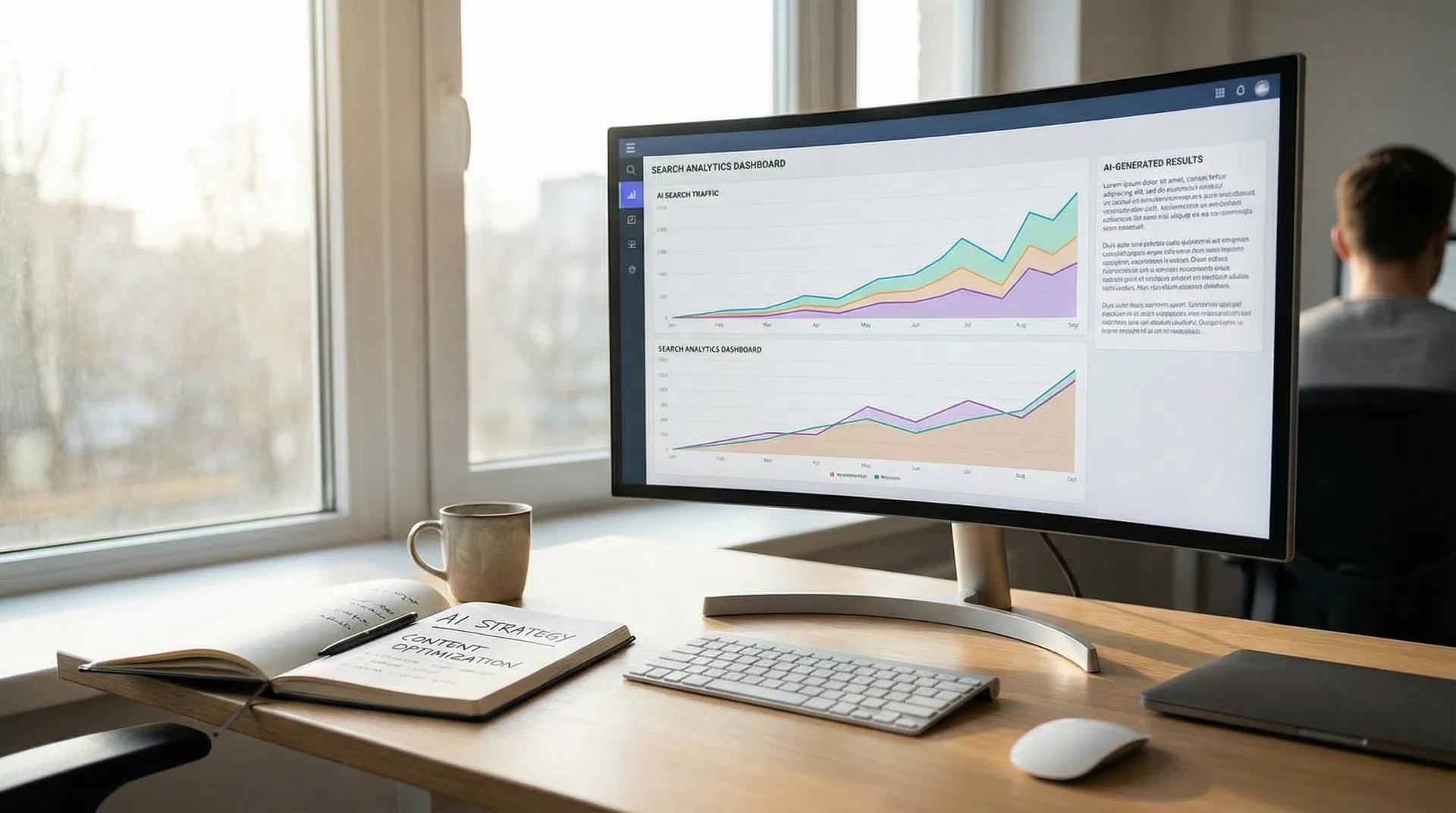
The End of "Rank and Bank": Search Has Been Restructured
Search did not gradually evolve in 2026. It restructured. Within a single calendar year, the way people find information, compare products, and make purchasing decisions shifted in ways that most marketing teams were not prepared for. If your strategy still centers on ranking a list of blue links, you are already behind.
According to PushLeads, AI-powered search tools collectively captured between 12% and 15% of global search market share by the end of 2025, up from approximately 5% to 6% at the start of the year. Google's global search market share dipped below 90% for the first time in over a decade, reaching approximately 89.74% in March 2025. Meanwhile, ChatGPT grew to 800 million weekly active users and now processes more than 1 billion queries per day, accounting for over 77% of all AI-driven website referral traffic globally.
These are not projections. These are current behaviors among people who are already shopping, comparing products, and making purchase decisions through AI-powered interfaces.
The Numbers That Should Keep Every Marketer Awake
The financial scale of this shift is staggering. McKinsey's analysis projects that by 2028, $750 billion in US revenue will flow through AI-powered search. Half of consumers polled in their survey already intentionally seek out AI-powered search engines, and a majority say it is the top digital source they use to make buying decisions.
But here is the uncomfortable truth: only 16% of brands currently track their AI search performance systematically. That 84% gap represents both a massive blind spot for most businesses and a significant competitive opening for the ones that move first.
The Adobe 2026 AI and Digital Trends Consumer Report, based on a global survey of 4,000 customers, adds another layer to this picture. Approximately 25% of customers now cite AI-powered platforms like ChatGPT as their top research tool — making these newcomers more popular than brand websites and online review platforms. Among customers who already use AI-powered platforms for research, reliance is remarkably high: 42% say they always or frequently rely on AI-powered assistants as their primary source for advice, shopping, or troubleshooting.
Why Traditional SEO Is No Longer Enough
The fundamental difference between traditional search and AI search lies in the output. Traditional search ranks pages. AI search composes answers. Where traditional SEO asks "how do I rank on page one?", AI-era strategy asks "how do I become part of the answer?"
The traffic data makes this shift painfully clear:
| Metric | Data | Source |
|---|---|---|
| Organic CTR drop on AI Overview queries | -61% | The SEO Spot |
| Zero-click searches (US) | 58.5% | PushLeads |
| Zero-click rate when AI Overviews present | 83% | PushLeads |
| Zero-click rate in Google AI Mode | 93% | PushLeads |
| Overall website click reduction from AI Overviews | -34.5% | SE Ranking |
Google's AI Overviews now reach 2 billion monthly users across 200 countries in 40 languages. Approximately 30% of all keywords in US SERPs now trigger an AI Overview, and each overview contains between 6 and 14 citations on average.
But the story is not all doom and gloom. Visitors referred by AI platforms spend 68% more time on websites compared to visitors from traditional organic search, and AI search traffic converts at a rate 4.4 times higher than traditional organic traffic. Revenue per visit from AI referrals reached up to 70% of the revenue per visit from non-AI traffic by May 2025, and that ratio has been improving each quarter.
The users who click through from AI search are further along in their decision-making process. They have already been briefed by an AI system and are clicking because they want to go deeper, verify something, or take action. That makes them significantly more valuable per visit.
The Brand Visibility Crisis: Your Website Is Only 5-10% of the Story
Perhaps the most sobering finding from McKinsey's research is this: brand websites account for only 5% to 10% of the sources AI-powered search references in many categories. The rest comes from affiliates, user-generated content, publisher content, review platforms, and third-party sites. In consumer packaged goods and financial services, more than 65% of sources in AI-powered answers are publishers, user-generated content, and affiliate sites.
This means that even if your website is perfectly optimized, you are only controlling a fraction of what AI systems say about your brand. The information ecosystem around your brand — reviews on independent platforms, coverage in industry publications, mentions in user-generated content — now determines your visibility in AI search.
Generative Engine Optimization (GEO): The New Core Capability
McKinsey describes Generative Engine Optimization as a "core capability" that organizations need to invest in to maintain competitive advantage in the AI era. GEO focuses on optimizing content and brand presence not just for Google's algorithm, but for the broader range of sources that large language models draw on when composing answers.
Here is a practical four-phase framework drawn from best practices documented by Semrush, McKinsey, and GEO practitioners:
Phase 1: Diagnose Your Current Position (Weeks 1-4)
Run a technical site audit to confirm your content is crawlable and indexable. Identify which of your pages already appear as citations in AI Overviews and other AI-generated responses. Audit your presence across ChatGPT, Perplexity, and Gemini for your key product and service categories. Note which sources — not just your own site — AI systems are using when they discuss topics relevant to your brand.
Phase 2: Rebuild Content for Extractability (Weeks 5-10)
AI systems favor content that directly answers questions in one or two clear sentences, followed by supporting detail. Use headings that mirror natural-language questions. Lead each section with the answer. Support with data, examples, and context. Add structured FAQ sections to pages where questions are commonly asked.
Phase 3: Expand Your Off-Site Footprint (Ongoing)
Since your website represents only a fraction of what AI systems reference, the information ecosystem around your brand matters enormously. Earn coverage in independent publications, industry journals, and review platforms. User-generated content, forum discussions, and community spaces like Reddit carry more weight in AI-generated answers than many marketing teams assume.
Phase 4: Measure What Actually Matters (Ongoing)
Track citation rate (how often your brand appears as a cited source in AI Overviews), mention frequency across ChatGPT, Perplexity, and Gemini, AI referral traffic and conversions, and branded search volume to see whether AI mentions translate into direct brand searches.
What AI Search Systems Actually Look For
Understanding the mechanics of how AI systems select content to cite is essential. Several consistent factors emerge from the research:
Clarity and directness. AI systems extract and synthesize. They favor content that directly answers the question implied by a heading, rather than content that builds slowly toward an answer.
Self-contained sections. Each section should function as a standalone answer. An AI system may extract a single section without the context of the rest of the article.
Freshness and accurate data. AI systems prioritize up-to-date, verifiable information. Content that uses specific statistics with attribution signals credibility.
E-E-A-T signals. Experience, Expertise, Authoritativeness, and Trustworthiness. Google's evaluation framework becomes more important in AI search. Firsthand experience, visible author credentials, and cited sources all contribute to trust signals.
Multimodal accessibility. Content that includes images with descriptive alt text, videos with transcripts, and audio with captions is interpretable by AI systems in ways that purely visual or audio content is not.
The 5-Second Rule: Why Relevance Beats Everything
The Adobe report reveals another critical insight for brands navigating this new landscape: 69% of customers say brands have five seconds or less to capture their attention in a promotional email, ad, or social media post. What drives engagement is not brand trust or familiarity, but immediate personal relevance, unique content, and authenticity.
This finding intersects directly with AI search strategy. When your brand appears in an AI-generated answer, the content cited must be immediately relevant and specific. Generic brand messaging will not earn citations. Detailed, data-backed, scenario-specific content will.
Furthermore, 70% of customers say it is very or moderately important that personalized offers and recommendations "feel human" rather than automated or robotic. This applies to AI search as well — content that reads like it was written by a knowledgeable human expert, not a content farm, is more likely to be cited and trusted by both AI systems and the humans reading those AI-generated answers.
The Bottom Line: Act Now or Disappear
The window for establishing a GEO presence is narrowing. Research from Over The Top SEO indicates that brands establishing a Generative Engine Optimization presence in 2026 will hold a three-to-five-times citation advantage over those that wait. AI-driven traffic is growing 165 times faster than organic traffic.
The brands that will win in 2026 and beyond are not the ones with the biggest ad budgets. They are the ones that understand how AI systems compose answers, ensure their brand is part of those answers, and build the off-site authority that AI systems trust.
The question is no longer whether AI search will reshape your industry. It already has. The question is whether your brand will be part of the answer — or invisible.
References
- PushLeads, "AI Search Market Share Data 2025," cited in ALM Corp, "AI Search Trends 2026," March 18, 2026.
- StatCounter, "Global Search Engine Market Share," March 2025, cited in ALM Corp, "AI Search Trends 2026."
- SE Ranking, "AI Search Referral Traffic and Citation Data," cited in ALM Corp, "AI Search Trends 2026," March 18, 2026.
- McKinsey & Company, "AI-Powered Search Revenue Projections and Brand Visibility Analysis," cited in ALM Corp, "AI Search Trends 2026."
- Adobe, "2026 AI and Digital Trends: Customer Behaviors and AI," Consumer Report, March 2026.
- The SEO Spot, "Organic CTR Impact from AI Overviews," cited in ALM Corp, "AI Search Trends 2026."
- TechCrunch, "Google AI Overviews Reach 2 Billion Monthly Users," cited in ALM Corp, "AI Search Trends 2026."
- Adobe, "Revenue Per Visit from AI Referrals," May 2025, cited in ALM Corp, "AI Search Trends 2026."
- Over The Top SEO, "GEO Citation Advantage Research," March 2026.
- Forbes Agency Council, "7 Ways To Prepare Your Brand For AI Search Dominance In 2026," March 16, 2026.
Related Articles
GEO vs SEO: How to Get Your Business Recommended by ChatGPT in 2026
Search is evolving beyond Google. Learn the 6-step GEO framework to optimize your content for ChatGPT, Perplexity, and other AI platforms that are redefining how customers discover businesses.

The AI Advertising Paradox: Why Context Determines Success in 2026
AI ads test better than traditional ads, yet consumers reject AI-generated content. Discover why context—not technology—determines advertising success in 2026, backed by System1, Nielsen Norman Group, and Porch Group Media research.

SEO in 2025: The Rise of Generative Engine Optimization (GEO)
As AI overviews dominate search results, traditional SEO is evolving into GEO. Learn the strategies to rank in the age of AI-generated answers.